Terms Of Access
Rhea Sharma




In the early years of its conception, the digital landscape was thought of as an open and democratic place defined by accessibility. Today, our experience of it is shaped by many layers of government, money-making, and behaviour modification. Digital platforms control visibility, businesses combine ownership, and lifestyle branding changes the way we think about our dependence on self-optimization. What was at first seemingly infinite is becoming more restricted.
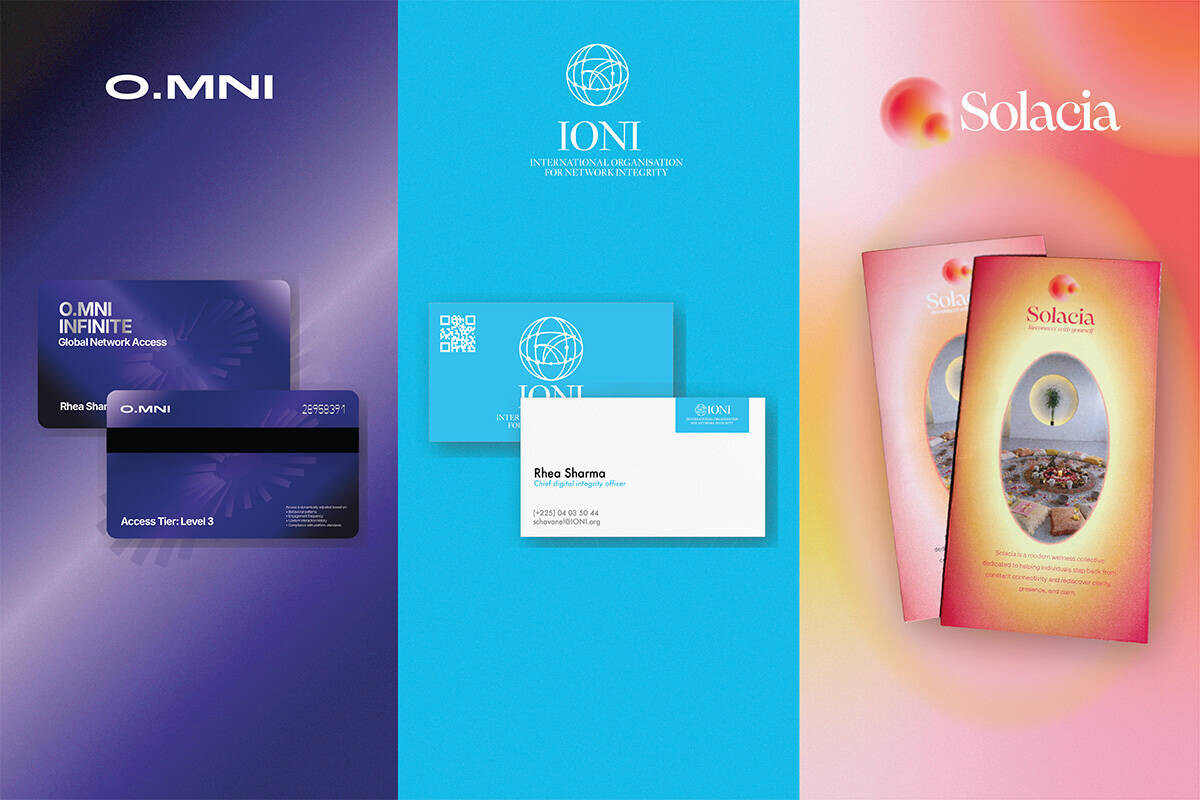
My thesis asks the question: if the internet has evolved into a critical infrastructure, who governs it, and how is that governance normalised? Instead of criticising these systems from the outside, I am holding up a mirror to a very possible reality in the near future.
The project constructs a speculative ecosystem of three interconnected entities: a governing authority, a corporate monopoly, and a wellness collective centered on digital abstinence. Each presents itself as a necessity—offering protection, improving access, and restoring balance— together reflecting how authority is legitimised and access is made into a commodity. I reflect the visual languages of modern wellness culture, corporate tech, and bureaucracy through immersive branding systems, websites, and physical objects.
The project examines how design’s power to reshape freedom while subtly constraining agency, converting the internet from a public commons into a controlled environment that masquerades as choice. In an increasingly digital reality saturated with options, do we truly have a choice?